USD


Custom gravel bike derailleur hanger accessories price list: Specification, Ordering and Quality Notes
Gravel derailleur hangers take the first hit when a bike is dropped, rack-strapped, or struck by trail debris. The failure usually shows at the seat radius, where the tab meets the dropout face, and a bent hanger produces ghost shifting or a dropped chain before the rider reaches the next aid station. A procurement officer qualifying a second source must match dropout face thickness, thread pitch, and hanger-eye concentricity to the original part, because a 0.1 mm offset at the interface defeats cable indexing no matter how the limit screws are set.
Material choice starts with the conditions the product will meet.
Design Constraints Behind the Specification
The specification is governed by three contact points: the dropout seat, the hanger eye, and the mounting thread. Dropout seat flatness determines whether the derailleur cage sits parallel to the cassette; hanger-eye true running determines whether the B-screw tension stays consistent across the cog range; thread engagement depth determines whether the hanger strips under torque before the frame dropout does. Complaint data from gravel OEMs shows the seat radius cracking first after repeated rock strikes, followed by thread galling when the hanger is installed dry or overtightened beyond the fastener spec.
Specification rule
Hanger eye alignment must hold within 0.15 mm of the dropout face plane. Beyond that tolerance, a 12-speed derailleur cage can shift far enough to drop the chain under load, which shifts warranty cost back to the component buyer.
How It Performs in Use
The hanger works as a sacrificial interface between the derailleur and the frame.
In service, load travels from the derailleur body through the hanger eye into the dropout seat. A stiffer 7075-T6 tab resists permanent bend under a single impact but transfers more shock to the carbon or aluminum dropout; a softer 6061-T6 tab bends predictably and can be realigned with a gauge tool, though repeated straightening work-hardens the alloy and invites fatigue cracks at the seat. Anodize thickness at the contact face decides how many wet rides pass before the finish wears through and corrosion starts at the aluminum-to-aluminum interface.
Materials and Construction Trade-offs
6061-T6 CNC
Standard gravel production. Machines cleanly, holds tight thread tolerances, and straightens in a shop alignment tool without cracking at typical service loads.
Bend resistance is moderate; permanent set appears after a hard rack strike or transport impact.
7075-T6 CNC
Specified when impact resistance outranks serviceability. Higher yield strength keeps the hanger eye closer to true after a single load event.
The alloy is less forgiving in a straightening tool and costs more per piece, with unit price rising roughly 15 to 25 percent over 6061-T6 depending on volume.
Construction choice follows weight priorities.
Bar-stock CNC produces a solid seat with full material thickness at the dropout face, which suits OEM replacement hangers sold by exact model. Stamped blanks finish faster and cost less at high volume, but the thinner web around the mounting thread can ovalize under repeated bolt torque, and the edge grain direction can accelerate fatigue cracking where the seat radius meets the tab. Hard coat anodize adds wear life at the dropout contact but increases the per-part price; clear anodize shows wear sooner but keeps thread gauge dimensions easier to verify.
How to Choose Before Requesting a Quote
Start the quote request with the dropout drawing, not a photo. The buyer needs dropout thickness, thread pitch (commonly M10 x 1.0 or M10 x 1.25 depending on frame origin), hanger-eye diameter, and the distance from dropout face to rear axle center. Derailleur brand matters because Shimano, SRAM, and SRAM T-type interfaces place the cage and B-screw at different offsets; ordering the wrong pattern means the hanger fits the frame but cannot index the cassette.
- Dropout face thickness and flatness tolerance
- Thread pitch and engagement depth
- Hanger-eye concentricity to the dropout plane
- Derailleur generation and cage length
- Finish: clear anodize, hard coat, or uncoated aluminum
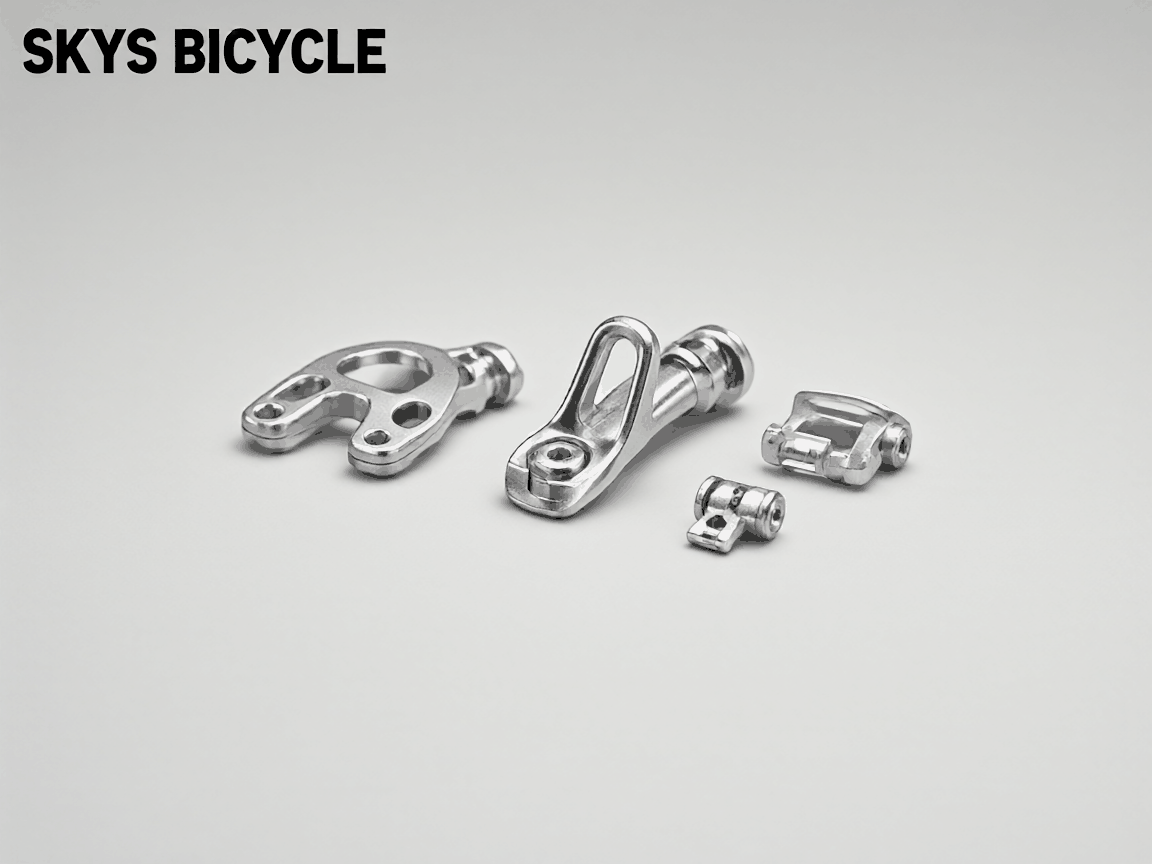
Price moves with tolerance grade and finish, not just alloy.
OEM and ODM Programme Structure
OEM orders run against a confirmed dropout pattern and branding on the hanger face or packaging label. ODM work starts from a frame dropout sample or CAD file; the factory cuts prototype hangers, checks alignment on a reference derailleur, and submits first articles for sample approval before tooling release. Private-label buyers should specify batch traceability marks so a failing hanger can be traced to a melt lot and run date rather than an anonymous shipment. For OEM tooling and sample approval, use the contact form.
MOQ and lead time scale with whether the dropout pattern is already tooled.
Stock Availability and Reorder Planning
Second-source qualification hinges on reorder continuity. A buyer should hold safety stock equal to one quarter of forecast usage, because gravel hanger demand spikes after race season when frames arrive for warranty service and shops need replacement tabs. Packaging configuration affects how many units fit in a master carton and whether the parts arrive loose or individually bagged for retail labeling.
| Item | Inner box quantity | Master carton quantity | Gross weight per carton |
|---|---|---|---|
| Standard hanger, poly bag | 50 | 500 | Approx. 9 kg |
| Hanger with mounting bolt kit | 25 | 250 | Approx. 11 kg |
| Retail blister card | 20 | 200 | Approx. 13 kg |
Lead time depends on whether the dropout pattern is in stock or needs cutting.
Request a quotation review
Submit your dropout drawing and annual volume for a tiered price list and sample lead time.
Start quotation review