USD


Specifying Factory Price cycling pedals and crankset components low moq for Wholesale and OEM Orders
Moving from sample orders to container loads changes what a buyer can tolerate in pedal and crankset variation. A pedal that passes a short demo ride can develop bearing play or spindle flex after 500 km if axle material and heat treatment do not match rider load.
During a private-label launch with a fixed ship date, the crankset and pedal specification is usually inherited from an existing platform rather than redesigned from scratch. The factory must hold spindle diameter, crank arm length, Q-factor and pedal stack height inside the tolerance band the brand already expects, while swapping finish, branding or bearing grade to hit a cost target. Forged 6061-T6 aluminum crank arms with CNC-machined pedal bosses keep thread engagement consistent across batches. Cast or sintered bodies introduce porosity that shows up as crank arm fatigue at the pedal interface after a few thousand revolutions.
Sealed cartridge bearings in the pedal spindle determine how long the pedal spins freely after the rider stops applying force.
Platform material drives the biggest cost split. Injection-molded nylon with fiberglass fill weighs roughly 380 to 420 g per pair and resists impact strikes, but the composite surface wears smooth under shoe abrasion and fades under sustained UV exposure. CNC-machined 6061 aluminum platforms add 80 to 120 g per pair but hold their profile and pin grip longer, at the cost of higher tooling spend per size. Chromoly steel spindles handle bending loads up to the rider weight limit without permanent set, while hollow chromoly shaves 40 to 60 g per spindle but loses stiffness under out-of-saddle sprint loads.
How It Is Built and What That Changes
Forging and machining determine where material sits under load. A forged crank arm aligns grain flow around the pedal boss, which delays fatigue cracks at the spindle interface. Machining the boss after forging holds thread concentricity within 0.05 mm, so pedal installation torque does not walk loose over time.
Pedal bearings are the first wear item a rider notices. Sealed cartridge units keep water and grit out of the spindle, while loose-ball designs need regular re-greasing to avoid corrosion inside the body.
Specification Range and Customisation Limits
Crank Arm Length
165, 170, 172.5, 175 mm
Pedal Stack Height
15 to 19 mm
Spindle Diameter
1/2 in, 9/16 in
Bearing Type
Sealed cartridge, loose ball
Platform Material
Glass-filled nylon, 6061-T6 aluminum
Finish
Anodized, painted, E-coating
Customisation stops where tooling cost begins. Changing chainring BCD or crank arm length requires a new forging die or CNC program, which raises the setup charge and lengthens sample time. Finish changes—anodized to painted or E-coated—can usually be made without new tooling, but they affect corrosion resistance in humid storage.
MOQ breaks align with batch size, not with component count.
Option Comparison by Usage Level
Usage level decides which material trade-off is worth paying for.
Entry-Level Commuter
Platform pedal, composite body, flat pins.
Forged aluminum crank, square taper or cartridge bottom bracket.
Approximate weight: 900 to 1100 g crankset, 400 g pedals.
Price driver: spindle material and bearing grade.
Performance Road or Gravel
Clipless mechanism, aluminum body, sealed cartridge bearing.
CNC spider, hollow crank arms, integrated bottom bracket.
Approximate weight: 650 to 800 g crankset, 280 to 340 g pedals.
Price driver: CNC time, hollow machining, anodize.
Requirements by Buyer Segment
An OEM buyer prioritizes batch consistency and documentation. Each crank arm and pedal pair must arrive with the same weight, stack height and spindle length so assembly line tolerances do not drift.
A brand product manager cares about retail compliance and service life. The specification must survive sweat on the pedal platform, UV exposure on a roof rack, and wash-down with degreaser without bearing seizure or finish delamination. Private-label branding on the crank arm and pedal body must hold up to the same cleaning cycle without peeling.
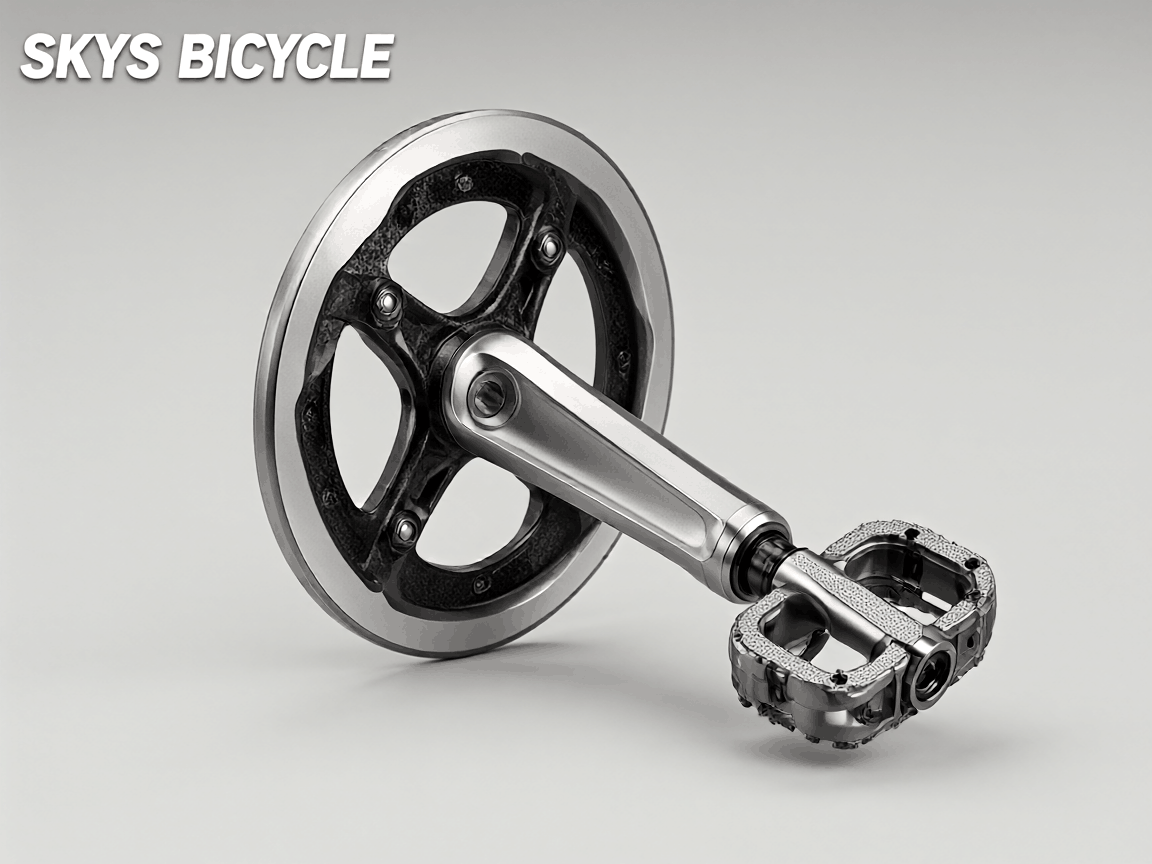
A procurement officer balances unit price against landed cost and reorder lead time. Low MOQ tooling amortizes across fewer units, so the price per crankset stays higher until volume absorbs the die charge.
Inspection Items and Test Methods
Factory inspection catches variation before it reaches the assembly line. Dimensional checks on spindle diameter and crank arm Q-factor use go/no-go gauges, while weight is checked per pair against a tolerance band. Bearing drag is measured in rotation torque, and spindle deflection is recorded under a static load equal to the maximum rider weight.
| Component | Material / Finish | Failure Mode | Test Method | Acceptance Limit |
|---|---|---|---|---|
| Pedal platform (composite) | Glass-filled nylon | Surface wear, UV fading | Abrasion cycle, UV exposure | No crack > 1 mm after 500 abrasion cycles; colour shift within batch tolerance |
| Pedal platform (aluminum) | Anodized 6061-T6 | Pin thread stripping, anodize wear | Torque-out test, abrasion | Pin retention > 8 Nm |
| Crank arm | Forged 6061-T6 aluminum | Fatigue at pedal boss | Rotating bend fatigue | 100,000 cycles at rated rider load |
| Spindle | Chromoly steel | Bearing play, spindle bend | Load deflection, rotation torque | Deflection < 0.15 mm at 200 kg |
| Bottom bracket | Sealed cartridge bearing | Seal contamination, corrosion | Salt spray, wash-down | No bearing roughness after 48 h salt spray |
Any component outside the acceptance limit is rejected or reworked before batch release.
Ordering, Tooling and Lead-Time Questions
What is the lowest MOQ for a private-label pedal and crankset combination? Low MOQ tooling is available for standard crank lengths and spindle diameters, but custom chainring BCDs require a new forging die and a higher minimum quantity.
Can I change chainring BCD without new tooling? No. A different BCD means a new spider or crank arm forging, so the setup charge and sample lead time increase accordingly.
How long does it take to move from approved sample to container load? Standard finishes usually ship within four to six weeks after sample approval; custom anodize or E-coating adds two to three weeks for the surface-treatment subcontractor.
What artwork files are needed for crank arm and pedal branding? Vector artwork with clear placement dimensions is required for laser etching or pad printing; raster images are not acceptable for crank arm logos.
Does the quoted price include bottom bracket and pedal spindles, or are they sold separately? Spindles and bottom brackets are priced per configuration; hollow spindles and sealed cartridge bottom brackets carry a separate unit adder.
How are batch variations in crank arm weight controlled? Each batch is sampled for mass on a calibrated scale; arms outside the stated gram tolerance are sorted out before packing.
To confirm spindle diameter, bearing grade or finish options against your private-label drawing, request a specification review.